ProspectPage
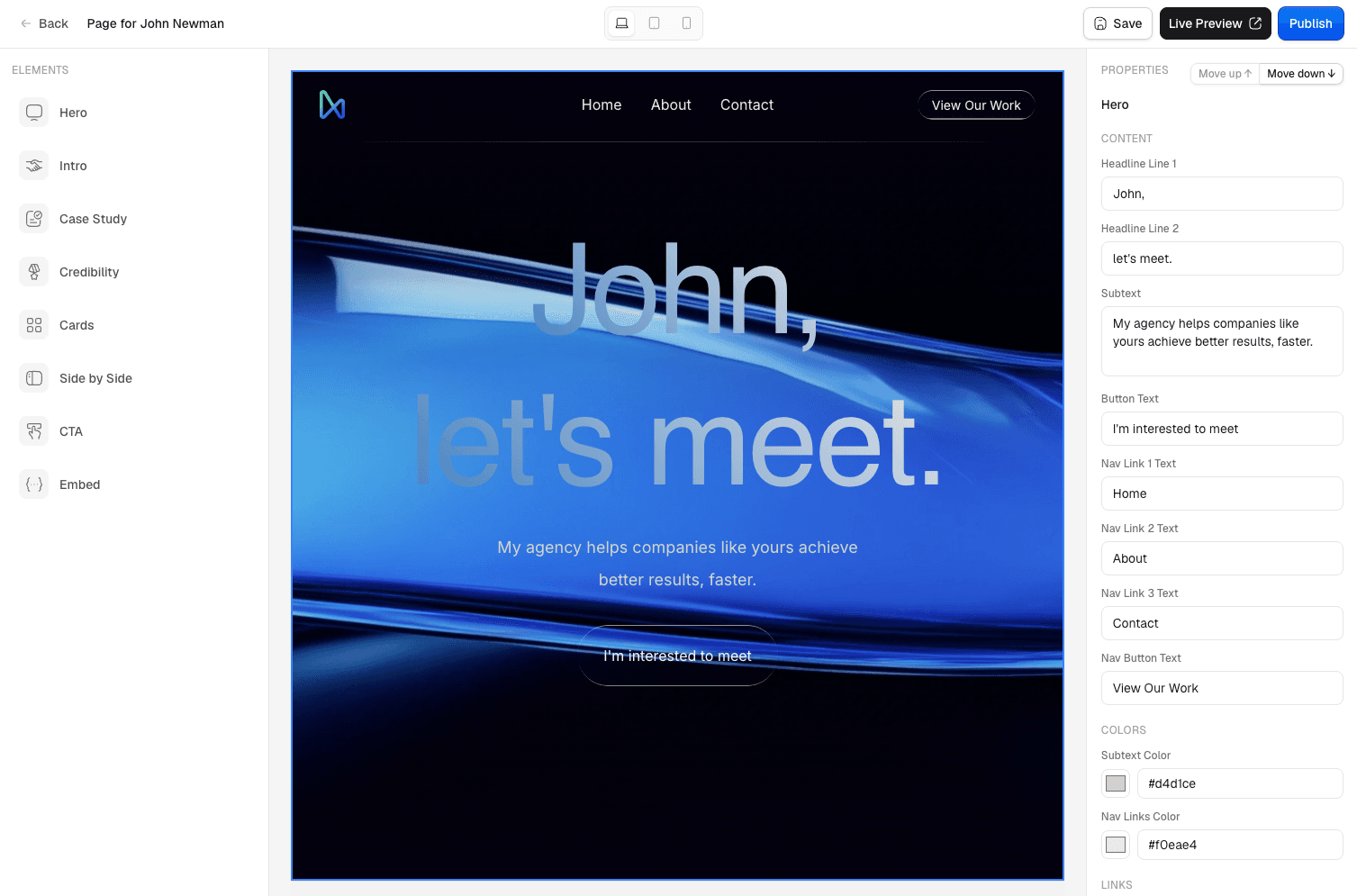
A personalized sales page is a scannable web page built for a single prospect. Their logo in the hero, their company named in the headline, a tailored proof point and even their photo on the landing page to show them you went a mile further. Using ProspectPage to pair one with every cold email lifts reply rates up to 16x, raises meeting show-rates, and shortens sales cycles, because the page does the early-stage education the first call used to do.
Last updated: May 22, 2026
For ten years, outbound has been a numbers game played in the inbox. Send more, get more. The problem is that prospects caught up. Inboxes are full. Buying committees are larger. Every template you can think of has been tried on them five times this quarter.
So a new pattern is replacing it. Instead of trying to fit everything into the email itself, top sales teams are sending a short cold email and pointing the prospect to a personalized sales page. A one-page micro-site built for that single account.
It works. And it works in a way that the old playbook does not. Here is what changed.
Why the email-only model is breaking
A cold email is constrained in three brutal ways. It has to be short. It has to render in any client. And it gets judged in under five seconds, mostly by a preview pane.
That is a hard envelope to fit "context + pitch + proof + ask" inside. So sellers either pick one (usually the pitch) or they cram all four and the email becomes a wall of text nobody reads.
A personalized sales page lifts the constraint. The email's only job becomes earning the click. Once the prospect lands on the page, you finally have room to actually communicate.
What a "personalized sales page" actually is
It is not a deck. It is not a video. It is a single, scannable and interactive web page with the prospect's name and logo at the top, written like it was built for them, because it was.
A good one usually has five elements:
- A hero that names the prospect. Their logo, a one-line headline that ties their world to your solution.
- Context paragraph. Two or three sentences proving you understand the specific tension they feel.
- Tailored proof. One customer story or data point that matches their stage, industry, or use case. Not your whole logo wall.
- A clear offer. What the next step actually is. A pilot. A call. A trial. Concrete, not "let's chat."
- A frictionless CTA. One button, ideally a calendar widget that books in two clicks.
That's it. The whole page should take the prospect under 90 seconds to read. The win condition is not "comprehensive." It is "they finish it."
Why this beats sending a deck
The instinct when you have more to say is to attach a deck. Resist it. Decks lose on three fronts compared to a personalized page.
- They don't get opened. A PDF attachment in a cold email is a credibility hit and often a deliverability one too.
- You can't see what happened. A deck is a black box. Did they open it? Which slide held their attention? You will never know.
- They don't feel personal. Even a custom slide in a deck still feels like a deck. A web page with their logo in the hero does not.
A personalized sales page solves all three. It opens in a browser, no download. It is fully trackable, you see exactly which sections held attention. And it feels like a piece of work, not a piece of collateral.
The data: what changes when you add a page
When teams move from "cold email only" to "cold email plus personalized page," a few things shift in a hurry.
- Reply rates go up because the CTA in the email becomes "worth a quick look?" instead of "open to a 15 min call?", a much lower bar.
- Meeting show-rates go up because by the time the prospect books, they have already self-qualified by reading the page.
- Sales cycles shorten because the page does the early-stage education the first call used to do.
Across the campaigns we see, the bottleneck moves from "getting a reply" to "getting through discovery faster." That is a much better problem to have.
How to build one without burning a week per page
The reason most sellers don't already do this is the same reason most sellers don't write fully custom emails. It sounds like it takes forever. It used to.
A few patterns make it tractable today:
Start from a template, not a blank page
Build one base layout with the structure above. For each prospect, you only change four things: the logo, the hero headline, the context paragraph, and the proof selection. The rest is reused. That is a 5-10 minute task once you have the rhythm, not an hour.
Use AI for the first draft of context
The "context paragraph" is where the personalization lives, and it is also the part that takes the longest to write. AI gets you 80% of the way there if you feed it the prospect's recent news, their job page, or their last LinkedIn post. You edit the last 20% so it sounds like you, not a robot.
Match the proof to the prospect, not your favorites
The most common mistake is dropping your three biggest logos on every page. Instead, pick the one customer story that matches this prospect's industry, size, or use case. One relevant case study beats five irrelevant ones every time.
Track what they did with it
The page is also a signal. If a prospect opens the page three times and scrolls to the bottom, that is a buying signal stronger than any reply. Send the follow-up in the next hour, not in three days.
Where this is going
The teams running ahead in outbound right now are not sending more emails. They are sending fewer, better-aimed touches, each one paired with a one-page site that does the heavy lifting the email cannot.
This is the direction outbound has been heading for years. Inboxes get harder. Prospects get more selective. Generic templates get filtered out by both software and humans. The only durable answer is to make each touchpoint feel like it was built for the person receiving it, because at some point soon, the senders who don't will simply stop getting replies.
That is the bet ProspectPage is built around. The next decade of outbound is not going to be won by the team with the biggest send volume. It is going to be won by the team whose every prospect feels like the only one on the list.
Related reading
How to increase cold email reply rates in 2026
Why tweaking subject lines stopped working, and the format shift that's replacing it.
See ProspectPage features
AI page generation, custom domains, real-time tracking, bulk campaigns, and more.
How personalized web pages lift cold outreach reply rates by 37%
The data behind the format shift and where the 37% reply-rate lift actually comes from.