ProspectPage
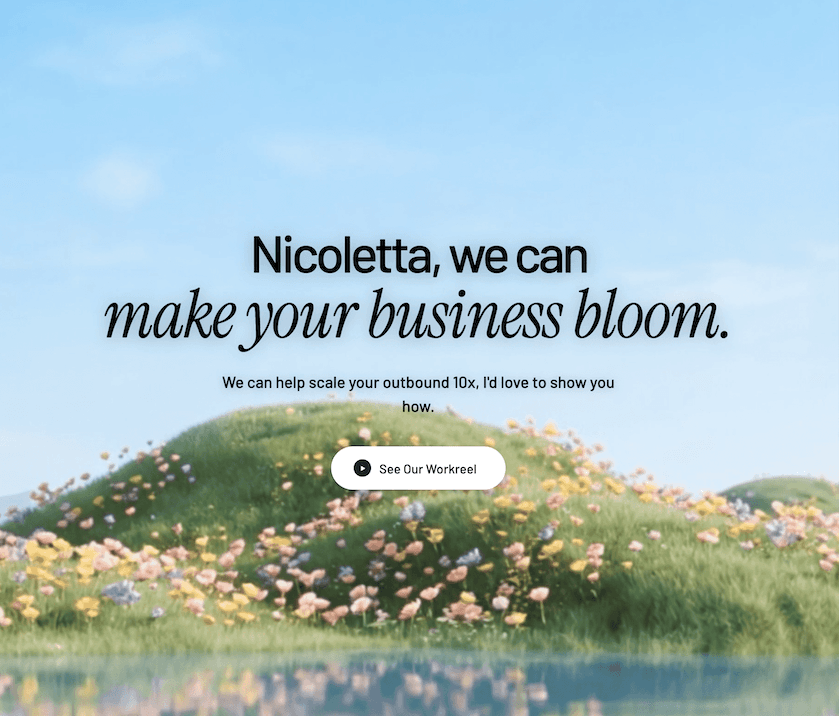
Sellers who pair every cold email with a personalized web page see an average reply-rate lift of 37% over email-only outbound. The shift works because the email no longer has to do all the selling. Its only job is to earn one click. The page does the context, the proof, and the ask, all framed around the specific prospect on the receiving end.
Last updated: June 1, 2026
We sit on a pile of campaign data nobody else has. Every cold outreach run through ProspectPage gives us a paired data point: the email send, and the personalized page on the other side of the link. When we compared sellers who use both to sellers running the same offers as email-only outbound, one number kept showing up.
37%.
That is the average lift in reply rate when a cold email is paired with a personalized web page instead of sent on its own. Not a one-off case study. Not a cherry-picked top performer. The average, across campaigns of every size, industry, and persona.
Here is why it works, and what the 37% is actually made of.
What "personalized web page" means in this context
It is not a landing page. Not a generic product tour. Not a deck behind a link.
A personalized web page is a one-screen site built for a single prospect, with their logo in the hero, their company named in the headline, a context paragraph written for their specific world, and one offer aimed at the move you actually want them to make.
The prospect lands on it and the signal is immediate: this was not blasted to 500 people. Somebody built this for me.
That signal is the entire reason the format works.
Where the 37% lift comes from
When we break down the campaigns where the lift shows up, it is not one single thing doing the work. It is three compounding effects.
1. The CTA in the email becomes lower friction
In email-only outbound, the CTA is usually a meeting. "Open to 15 minutes next week?" That is a big ask for someone who has known you for four seconds.
When there is a page on the other side of the link, the CTA collapses to "worth a quick look?" That is the lowest-friction ask in B2B. The prospect is not committing to a call. They are committing to scrolling for 30 seconds.
Lower-friction CTAs reply at higher rates. That alone accounts for a big slice of the 37%.
2. The page does the proof the email cannot
A cold email has room for one or two sentences of proof, if you are lucky. Most of the time even that gets cut to keep the message short.
A personalized page has room for the right proof. A customer story from the prospect's industry. A specific metric that matches their stage. A short Loom from the founder addressed to their team. Each of those raises the odds of a reply, because the prospect now has a reason to write back beyond "you sounded interesting."
3. The follow-up has new material
The page is also a tracking surface. You see who opened it, which sections they spent time on, whether they shared the link inside their company. That gives the follow-up a real reason to exist.
"Just bumping this up" is dead. "I saw three people from your team opened the page yesterday, want me to walk the marketing org through how this fits?" is a meeting.
A lot of the 37% lift shows up not in first-touch reply rates but in the second and third touches, where email-only campaigns flatline and paired campaigns keep replying.
Why the lift is bigger in cold than in warm
We see the 37% number on truly cold outbound. On warm intros and reactivated accounts the lift is smaller, usually in the 10 to 15% range, because the prospect already has context for who you are.
Cold is where the format change earns its keep. The colder the audience, the more the personalized page has to do, and the bigger the gap between "email-only" and "email plus page" gets.
If you are running outbound into accounts that have never heard of you, this is the lever with the biggest payoff per hour of work.
What this does to your campaign math
A 37% reply-rate lift sounds modest until you run it through a real funnel.
Start with a standard outbound campaign. 1,000 sends. 3% reply rate. 30 replies. Of those, maybe a third turn into meetings. 10 meetings booked.
Now apply the lift. 1,000 sends, 4.1% reply rate, 41 replies, 13 to 14 meetings. From the same effort, the same list, the same offer.
Stack that across a quarter and the difference between hitting pipeline targets and missing them is whether the email had a personalized page behind it.
What it does NOT mean
We should be honest about what the 37% does not unlock.
It does not fix a bad ICP. If you are sending to prospects with no real reason to care about your product, no format change saves the campaign.
It does not fix a vague offer. If the page itself is generic, branded fluff with no specific call to action, the prospect will bounce just like they would from a bad landing page.
And it does not work if the email is also bad. The email still has to be sharp enough to earn the click. The page picks up after that.
What the 37% does mean is this: when the targeting, the offer, and the writing are all decent, the format swap from "email-only" to "email plus personalized page" is the single highest-ROI change you can make to outbound. Most teams have already squeezed everything they can out of subject lines and follow-up cadences. The format itself is the layer that is still wide open.
How to start without rebuilding your whole motion
The reason this is not already industry standard is that until recently, building a custom web page per prospect was a half-hour design exercise per account. At outbound volume that math does not work.
The piece that changed is how much of the page can be reused. A campaign on ProspectPage works like this.
- Build one base page with your pitch, your proof, and your offer. This is a one-time cost.
- Upload your prospect list. The logo, domain, and basics get pulled in automatically.
- For each prospect, the only thing you (or the AI) write fresh is the hero headline and a two-sentence context paragraph.
- Each prospect gets a unique URL. You drop it into the email. The page does the rest.
What used to be 30 minutes per prospect collapses to two or three. That is what makes the 37% reach the bottom line instead of dying inside your ops bottleneck.
The takeaway
Outbound has been a numbers game for a decade and the numbers are getting worse every year. Inboxes are full. Templates are burned. The senders pulling double-digit reply rates in 2026 are not the ones with the best email copy. They are the ones who moved the actual pitch out of the email and onto a page that was built for the person reading it.
37% is the average lift we see across that switch. Some teams see less. Some see 3x or more. The point is the lift is real, it is measurable, and it is the cheapest thing you can do to your outbound this quarter that is not already a commodity.
If you want to see what the format looks like in practice, check out our other resources to learn more.
Related reading
How to increase cold email reply rates in 2026
Why tweaking subject lines stopped working, and the format shift that is replacing it.
Personalized sales pages: the new outbound playbook
What a personalized sales page actually is, and why top GTM teams pair one with every cold email.
Browse page examples
Real personalized sales pages built on ProspectPage.
Tagged with