ProspectPage

The cold outreach techniques that book calls in 2026 prove you did real, hand-crafted work made for one prospect and no one else. The highest-leverage play is a personalized landing page, because a page carries far richer information than an email: their logo, their company in the headline, a matched proof point, and one clear next step on a single screen. Then stack a few hand-made touches on top: a short Loom, a cake to their office, a 30-second voice note, an AI-generated image that drops them into the story.
Last updated: June 19, 2026
Outbound used to reward volume. Send more, book more. That trade stopped paying out somewhere around the time every prospect started getting forty near-identical emails a week, all opening with the same "I noticed you're the VP of..." line that a tool wrote.
In 2026, the prospect's filter is simple. Did a human do real work here, or did a sequence spray me? If it reads like a spray, it is gone in under two seconds, and no amount of follow-up rescues it.
So the teams still booking calls have stopped optimizing for volume and started optimizing for proof of effort. Every technique below is a different way to prove, in the first three seconds, that this touch was built for one person. None of them require you to be clever. They require you to be specific.
Here are the nine that work right now.
1. Build a personalized landing page for every prospect
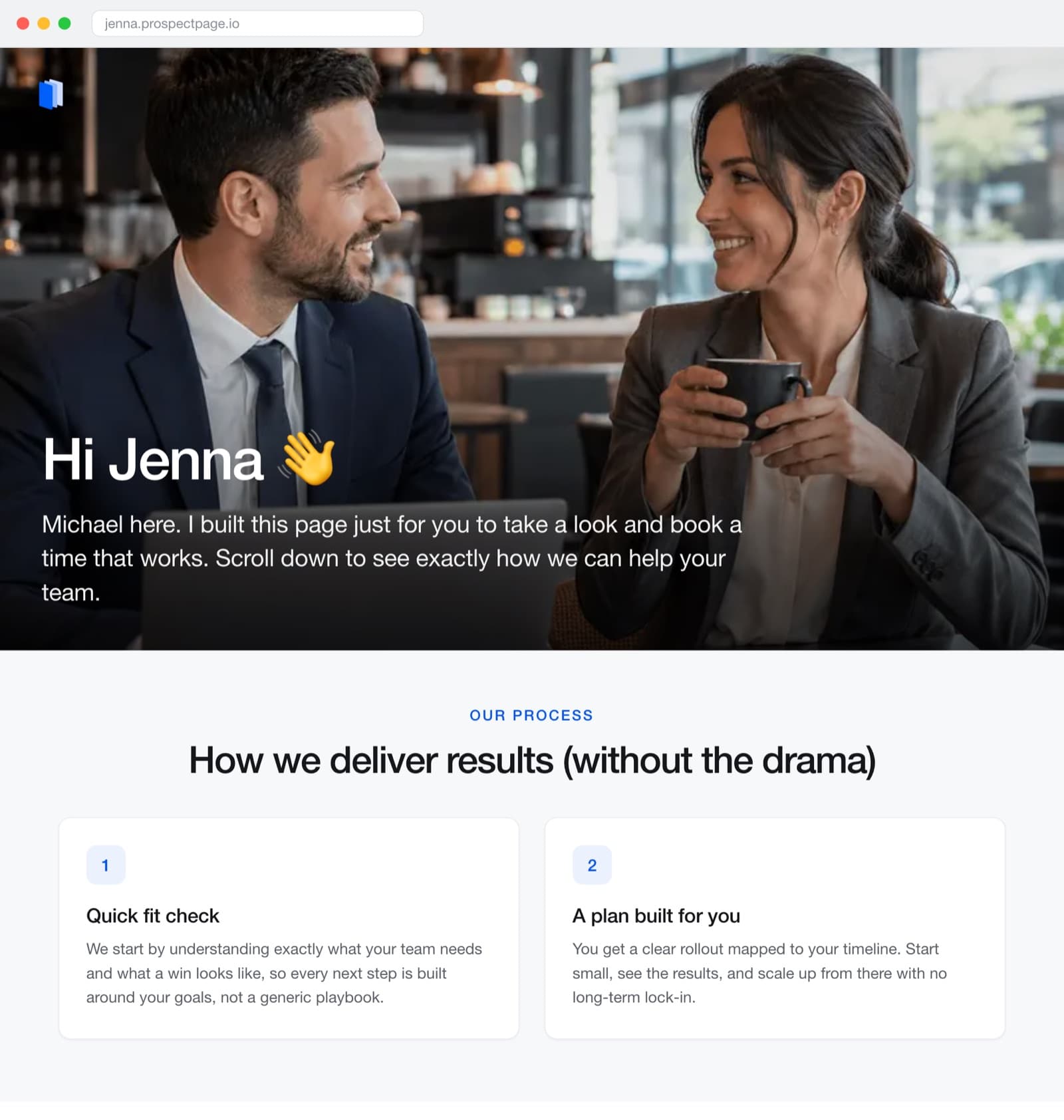
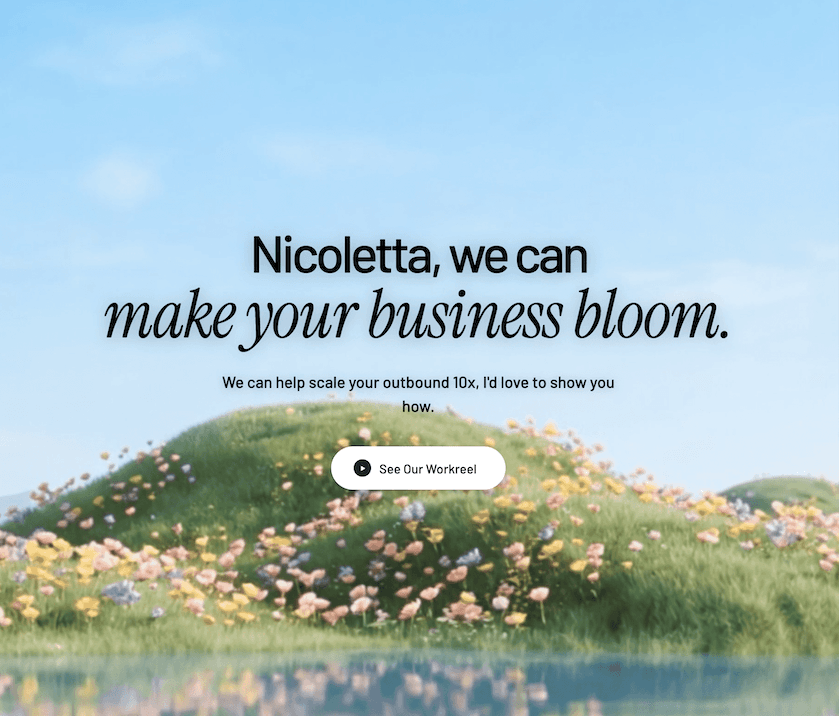
This is the single highest-leverage personalization move available right now, which is why we built ProspectPage around it. Instead of cramming context, pitch, proof, and ask into an email nobody finishes, you send a three-line email whose only job is to earn one click, and you point the prospect at a one-page micro-site built for them.
Their logo in the hero. Their company named in the headline. One proof point that matches their industry and stage, not your whole logo wall. A single calendar CTA at the bottom.
It works because the bar to click "worth a quick look?" is far lower than the bar to reply "yes to a 15-minute call." By the time the prospect books, they have already read the page and self-qualified. The page also tells you who is interested: if someone opens it three times and scrolls to the end, that is a stronger buying signal than any reply, and your follow-up should go out within the hour.
2. Send a 30-second voice note

A voice note on LinkedIn or in the inbox does something text cannot: it proves a human took thirty seconds out of their day specifically for this person. You cannot fake a voice note at scale. That is exactly why it lands.
Keep it short and unpolished. Name the prospect, name the one specific thing you noticed about their company, ask one question. Thirty seconds is the ceiling, not the target. The goal is not to pitch. It is to sound like a real person who has clearly done their homework, because you have.
The failure mode is the scripted voice note that sounds like an ad read. If you would not say it to a colleague in the hallway, rewrite it. The whole advantage here is that it feels off the cuff.
3. Record a personalized Loom video

A short screen-share video raises the proof-of-effort bar even higher. Open with your face in the corner, say the prospect's name, then share your screen and walk through something specific to them: their website, their pricing page, their job listings, a gap you noticed in their funnel.
The trick is to make the first frame personal. Hold up a piece of paper with their name on it, or have their homepage already open on screen. Most video thumbnails look identical, so when the prospect sees their own logo in the preview, they click.
Keep it under ninety seconds. You are not delivering the pitch. You are showing them you looked closely enough to have something specific to say, which is the thing no template can imitate.
4. Reference their own words

Your prospects are publishing more than ever. Podcasts, LinkedIn posts, conference talks, founder interviews, quarterly letters. Almost nobody on the sending side actually consumes any of it before reaching out.
So when you quote a specific line from the prospect's own podcast episode or reference a point they made in a post last week, you instantly separate yourself from every other sender in the inbox. Not "I loved your content." That is worse than nothing. Quote the actual sentence, then connect it to the reason you are reaching out.
This is the cheapest technique on the list to execute and the easiest to do badly. The line between "this person listened to my episode" and "this person ran a search and pasted a title" is obvious to the prospect. Do the listening.
5. Time the outreach to a real trigger event

The same message lands completely differently depending on when it arrives. A prospect who just closed a funding round, posted a new role, launched a product, or changed jobs is in a window where your problem suddenly became their problem.
Set up alerts for the triggers that map to your offer. New VP of Sales hired? That person has ninety days to prove they can build pipeline. A funding announcement? Budget just unlocked. A wave of new job postings in one department? They are scaling something and feeling the strain.
When your outreach references the trigger directly, it stops reading as a cold pitch and starts reading as a timely, relevant observation. You are not interrupting. You are showing up at the exact moment the prospect started caring.
6. Send a custom teardown they can actually use

Give before you ask. Instead of describing what you could do for the prospect, do a small slice of it for free and hand it over. A two-minute audit of their checkout flow. A teardown of their cold email if you sell to sales teams. A short list of three things you would change on their pricing page.
The value has to be real. A "free audit" that is obviously a thinly disguised pitch is worse than silence. But a genuinely useful teardown does two things at once: it proves you understand their business, and it shows what working with you would actually feel like.
Pair this with technique one and you have something powerful: the teardown lives on a personalized page, and you can watch exactly which parts they read.
7. Send a cake to their office

Physical mail is rare enough now that it is almost guaranteed to get noticed. A cake to the office, a book the prospect mentioned they wanted to read, a small branded item tied to an inside joke from their content. It does not need to be expensive. It needs to be unexpected and specific.
The reason this works is reciprocity. When someone sends you something thoughtful, ignoring them feels rude in a way that ignoring an email never does. You are not buying a meeting. You are starting a relationship with a gesture that cost you effort, and effort is the entire currency of cold outreach in 2026.
Reserve this for accounts that justify the cost. It is a high-effort, high-conversion play, not a volume tactic. Use it on the twenty accounts you genuinely want, not the two thousand on the list.
8. Drop the prospect into an AI-generated scene

This one is newer and it surprises people every time. Using AI image generation, you can build a scene that fits the story you are telling. A friendly shot of you and the prospect standing side by side, like you already know each other. Their logo on a billboard. Their product on a shelf in a busy store. A lightly humorous setup at a golf course or a rooftop bar.
Inside ProspectPage, you can generate these images and drop them straight onto the prospect's personalized page, so the visual and the pitch live in the same place. The image stops the scroll, and the personalized page does the rest.
The key is taste. The image should make the prospect smile, not feel uncanny. Used well, it is the most memorable thing in their inbox that week, and memorable is what gets you the reply. You can see how the generation works on our AI image generation feature page.
9. Mail a handwritten postcard

Email is free, which is exactly why it gets ignored. A postcard with two or three handwritten lines is the opposite. It costs you a stamp and ninety seconds, and almost nobody else is doing it. That rarity is the entire point.
Handwriting cannot be faked at scale, so it reads as real effort the moment it lands on the desk. Keep it short. Write the prospect's name, name the one specific reason you are reaching out, and point them somewhere easy to act on: a short link to their personalized page, or a calendar. Do not try to close on a postcard. Its only job is to make your name familiar before your email or call ever arrives.
This works best as a primer, not a standalone. A postcard that lands the same week as your email turns a cold name into one the prospect has already seen, and the second touch is always warmer than the first. It is cheaper than the cake, so you can run it across more of your list, not just the top twenty.
What to focus on today
You do not run all nine on every prospect. You match the effort to the account, and you start with the one that carries the most weight: the personalized landing page.
The old objection was that pages do not scale. You cannot hand-build a hundred of them. That is no longer true. Inside ProspectPage, you drop in a single CSV file and generate 100 landing pages, each one personalized to a single prospect, in a matter of minutes. The logo, the headline, the proof point, and the copy adjust per row. What used to be a full afternoon of work per page becomes one upload for the whole list.
This is what personalization at scale actually looks like. You get the depth of a page hand-made for one person and the reach of a normal sequence at the same time, with no trade-off between the two. Start there this week. Point your next campaign at a personalized page instead of the inbox, then layer the higher-effort touches, a Loom, a voice note, a cake, onto the named accounts you most want to win.
The thread running through all nine is the same. Cheap to engage with, expensive to fake. That is the only definition of personalization that still moves reply rates in 2026, and it is the bet ProspectPage is built around: the next decade of outbound goes to the team whose every prospect feels like the only one on the list.
Related reading
How to increase cold email reply rates in 2026
Why tweaking subject lines stopped working, and the format shift that's replacing it.
Personalized sales pages: the new outbound playbook
What a personalized sales page is, why it beats a deck, and how to build one fast.
Steal our outbound playbook (with a free personalized-page template)
The full step-by-step playbook behind these techniques, plus a template you can send today.