ProspectPage
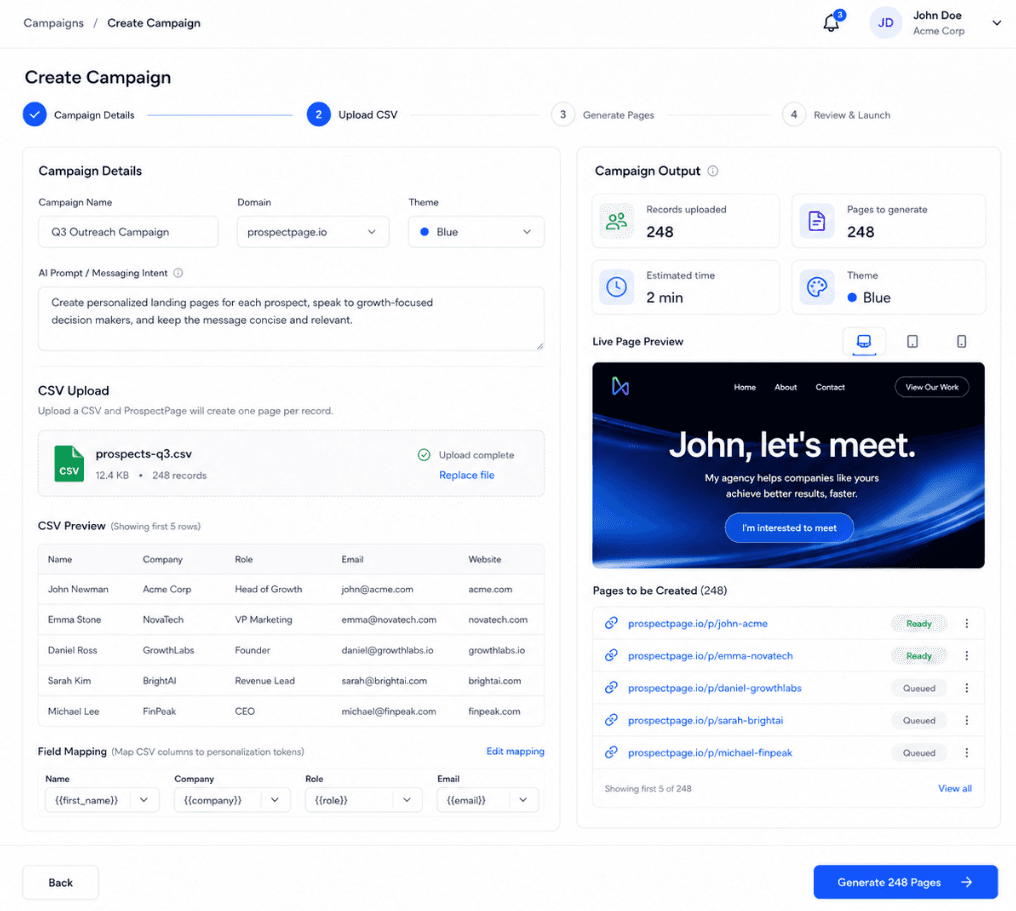
The fastest way to increase cold email reply rates in 2026 is to stop trying to sell inside the email. Send a three-line email whose only job is to earn a click, and point every prospect at a personalized sales page built for them. Teams that make this shift and start using tools such as ProspectPage typically move reply rates from 2-3% to 10-15%, with shorter sales cycles and higher meeting show-rates.
Last updated: May 28, 2026
If you have ever sent a cold email, you know the feeling. You craft something you think is sharp, hit send to 200 prospects, and a week later you have three replies. Two are "unsubscribe."
The reflex is to fix the email. Rewrite the subject line. Tighten the opener. Add another follow-up. Test a new CTA.
We have watched thousands of campaigns run on ProspectPage, and here is the uncomfortable truth: tweaking the email is the wrong layer to fix. The reason your reply rate is stuck at 2% is not your subject line. It is that the cold email itself, as a format, is asking the prospect to do too much in too little space.
The teams pulling 10-15% reply rates in 2026 are not the ones with the best email copy. They are the ones who stopped trying to win inside the email and started pairing every send with a personalized sales page.
Why cold email by itself has hit a ceiling
A cold email is constrained in three brutal ways. It has to be short. It has to render in any client. And it gets judged in under five seconds, mostly from a preview pane.
That envelope cannot hold "context + pitch + proof + ask." So you pick one (usually the pitch) and the prospect bounces because they have no reason to care yet. Or you cram all four and the email becomes a wall of text nobody reads.
This is why "better subject lines" and "shorter copy" have stopped moving the needle. You are optimizing a format that is structurally too small for the job.
The shift: the email's only job is the click
When you change the goal of the email from "convince the prospect" to "earn one click," everything gets easier.
Your email becomes three lines. One line of specific context about the prospect. One line that hints at the tension or tradeoff they probably feel. One line that ends in "worth a quick look?" with a link to a page built specifically for them.
That email writes itself in two minutes. It deliverability is better because it is short and link-light. It reads native on mobile. And the CTA, "worth a quick look?", is the lowest-friction ask in cold outreach. It is not "give me 15 minutes." It is "give me 30 seconds of scrolling."
The page on the other side of that link is where the actual selling happens.
What a personalized sales page does that an email can't
A ProspectPage opens in a browser. It has the prospect's logo in the hero. The headline names their company. The body talks about their world. Not "companies like yours," but actually theirs.
Five things change the moment you move the pitch out of the email and onto a page.
- You finally have room. A page can carry the context, the pitch, the proof, and the ask without compromising any of them. Each element gets the space it needs.
- It feels personal because it is. A prospect seeing their own logo and name at the top of a page processes it differently than the same words inside an email. The signal that you actually did the work for them is unmistakable.
- You can show, not just tell. Embed a 60-second Loom. Show the exact dashboard view their team would have. Drop in a case study from someone in their industry. None of that fits in an email.
- You see exactly what they did with it. Which sections they read. How long they spent. If they shared the link internally. That visibility is impossible with an email and a calendar link.
- Your follow-ups have a reason to exist. "Just bumping this" is dead. "I saw three people from your team opened the page yesterday, happy to walk you through the use case for the marketing org" is a meeting.
The math actually changes
This is not a marginal improvement. When teams swap "email-only" for "email + personalized page," the numbers move in a predictable pattern.
- Reply rates 2-3x. The CTA went from "book a meeting" to "look at a page", a much lower bar.
- Meeting show-rates climb. By the time someone books a call, they have already self-qualified by reading the page. Ghosting drops.
- Sales cycles shorten. The page does the early-stage education the first call used to do. You start the call on slide three, not slide one.
The bottleneck stops being "getting a reply" and becomes "keeping up with the inbound from people who already read your page." That is a much better problem to have.
"But personalized pages take forever to build"
This is the objection everyone starts with, and ten years ago it was correct. Today it isn't.
The reason ProspectPage exists is to make the parts that scale (the layout, the proof, the tracking, the deliverability) feel as light as the parts that have to stay human (the writing about that specific prospect).
A campaign on ProspectPage works like this:
- Build one base page that captures your pitch, your proof, and your CTA.
- Upload your prospect list. For each prospect, we auto-pull their logo, their domain, and the basics, and you (or the AI) write the personalized hero and context paragraph.
- Each prospect gets a unique URL. The email is three lines. The page does the rest.
- You watch in real time which prospects opened, which sections they read, and which ones to follow up with first.
What used to be an hour of design work per prospect collapses to a few minutes of writing. That is what makes the math work at outbound volume.
Stop optimizing the wrong thing
If your reply rate is stuck at 2-3% and you are testing your fourth subject line variation this month, you are optimizing the wrong layer. The email is not the problem. The format is.
The senders pulling double-digit reply rates are not better writers than you. They are sending shorter emails, because each email is a question, not a pitch, and they are pointing every prospect at a page that was actually built for them.
That is the shift. Cold email stops being the place you sell. It becomes the place you earn the click. And the personalized sales page on the other side is where reply rates that used to sound like fantasy become the new normal.
If you want to see what a ProspectPage looks like in practice, start a free trial. You can build your first one in under ten minutes and send it to a prospect today.
Related reading
Personalized sales pages: the new outbound playbook
Why top sales teams are pairing every cold email with a one-page site built for that single prospect.
See ProspectPage features
How the platform handles AI page generation, custom domains, real-time tracking, and bulk campaigns.
How personalized web pages lift cold outreach reply rates by 37%
The data behind the format shift and where the 37% reply-rate lift actually comes from.
Tagged with