ProspectPage

The outbound playbook that still books meetings is short: pick a small list of accounts you actually want, send a three-line email whose only job is to earn one click, and point that click at a page built for one prospect. The email does not pitch. The page does. It carries their logo, their company in the headline, one matched proof point, and a single calendar CTA, all on one screen. You can copy our template, fill in one prospect, and send it in the next ten minutes.
Last updated: June 18, 2026
Most outbound advice tells you to test another subject line. We stopped doing that a year ago, and our reply rates went up, not down.
Here is the whole playbook we run at ProspectPage, with nothing held back. You can copy it line for line. At the end, there is a template you can fill in and send today, plus the exact tool we use to do it across a whole list at once.
The thread running through all of it is simple. The email is not where you sell. The email earns a click. The page does the selling.
Why the email-only approach stopped paying out
Outbound used to reward volume. Send more, book more. That trade stopped working once every prospect started getting forty near-identical emails a week, all opening with the same "I noticed you're the VP of..." line that a tool wrote.
The prospect's filter is now one question. Did a human do real work here, or did a sequence spray me? If it reads like a spray, it is gone in two seconds, and no follow-up rescues it.
An email is also a bad container. You cram context, pitch, proof, and the ask into a wall of text nobody finishes. A page does not have that problem. It can show their logo, name their company, hold a screenshot, and put one clear next step on a single screen. So we stopped trying to win inside the inbox and moved the real work to a page.
The playbook, step by step
Step 1: Pick 25 accounts, not 2,500
Start narrow. Pull a list of 25 accounts you genuinely want to win this month, where you can name a real reason each one would care.
A short list you can personalize beats a long list you cannot. Twenty-five pages that feel hand-made will out-book a thousand emails that feel like a mailshot, and you will spend less time doing it.
Step 2: Write a three-line email that only asks for a click
The email has one job. Earn the click. That is it.
Three lines. Name the prospect. Name the one specific thing you noticed about their company. Point them at their page with a single link. Do not pitch, do not list features, do not attach a deck.
Hi Jenna,
Saw Northwind just opened a second support team in Austin, so I put together a short page on how teams your size cut first-response time. Worth a 30-second look? [link]
Either way, good luck with the Austin launch.
That is the whole email. The bar to click "worth a quick look?" is far lower than the bar to reply "yes" to a 15-minute call. You are not asking for the meeting yet. You are asking for thirty seconds of attention.
Step 3: Send the click somewhere built for one person
This is the part that does the work. The link goes to a page made for that single prospect.
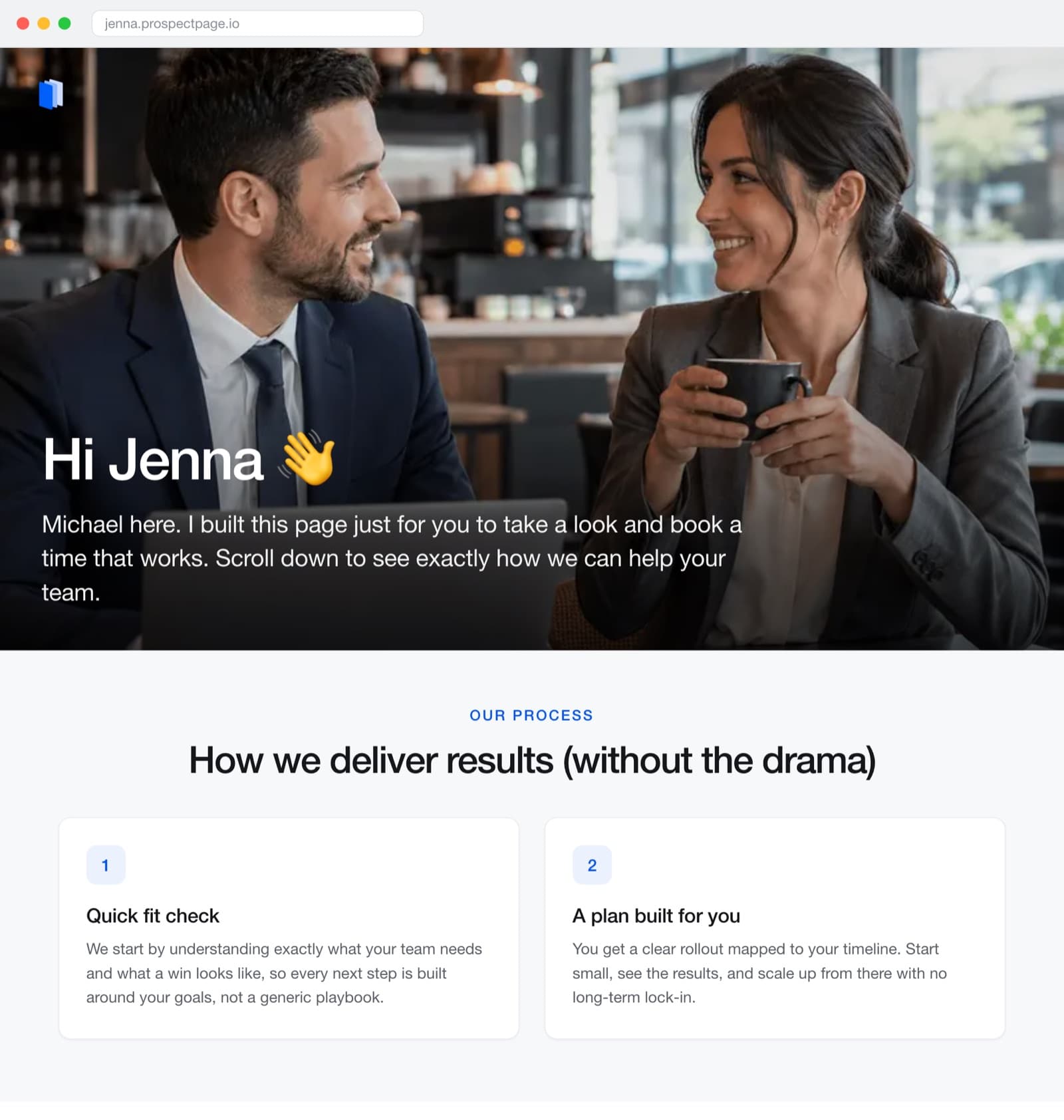
Their logo in the hero. Their company named in the headline. One proof point that matches their industry and stage, not your entire logo wall. A short, relevant screenshot. A single calendar CTA at the bottom.
By the time the prospect books, they have already read the page and self-qualified. The page also tells you who is warm. If someone opens it three times and scrolls to the end, that is a stronger buying signal than any reply, which leads to the last step.
Step 4: Let the page tell you when to follow up
Stop following up on a fixed "day 3, day 5" cadence. Follow up on behavior instead.
When a prospect opens their page a second time, or scrolls all the way through, that is your signal. Reach out within the hour, while the page is still on their mind. A follow-up timed to real interest reads as attentive, not desperate, and it converts far better than a calendar-based nudge sent to someone who never opened anything.
The free template you can steal
Here is the part you came for. This is the page structure we use, the same one behind the screenshot above. Copy it as-is and swap in your prospect.
- Hero: "[Prospect company] + [Your company]" with their logo, and a headline naming the outcome they care about.
- One-line subhead: the specific reason this page exists, in their words.
- One proof point: a single matched result or screenshot, not your whole case-study library.
- Short relevance block: two or three lines on why this applies to their team specifically.
- One CTA: a single calendar link. No second ask competing with it.
You can build this by hand for one prospect right now. The catch is the obvious one: hand-building 25 of them, let alone 250, is a full afternoon of work per page. That is exactly the problem we built ProspectPage to remove.
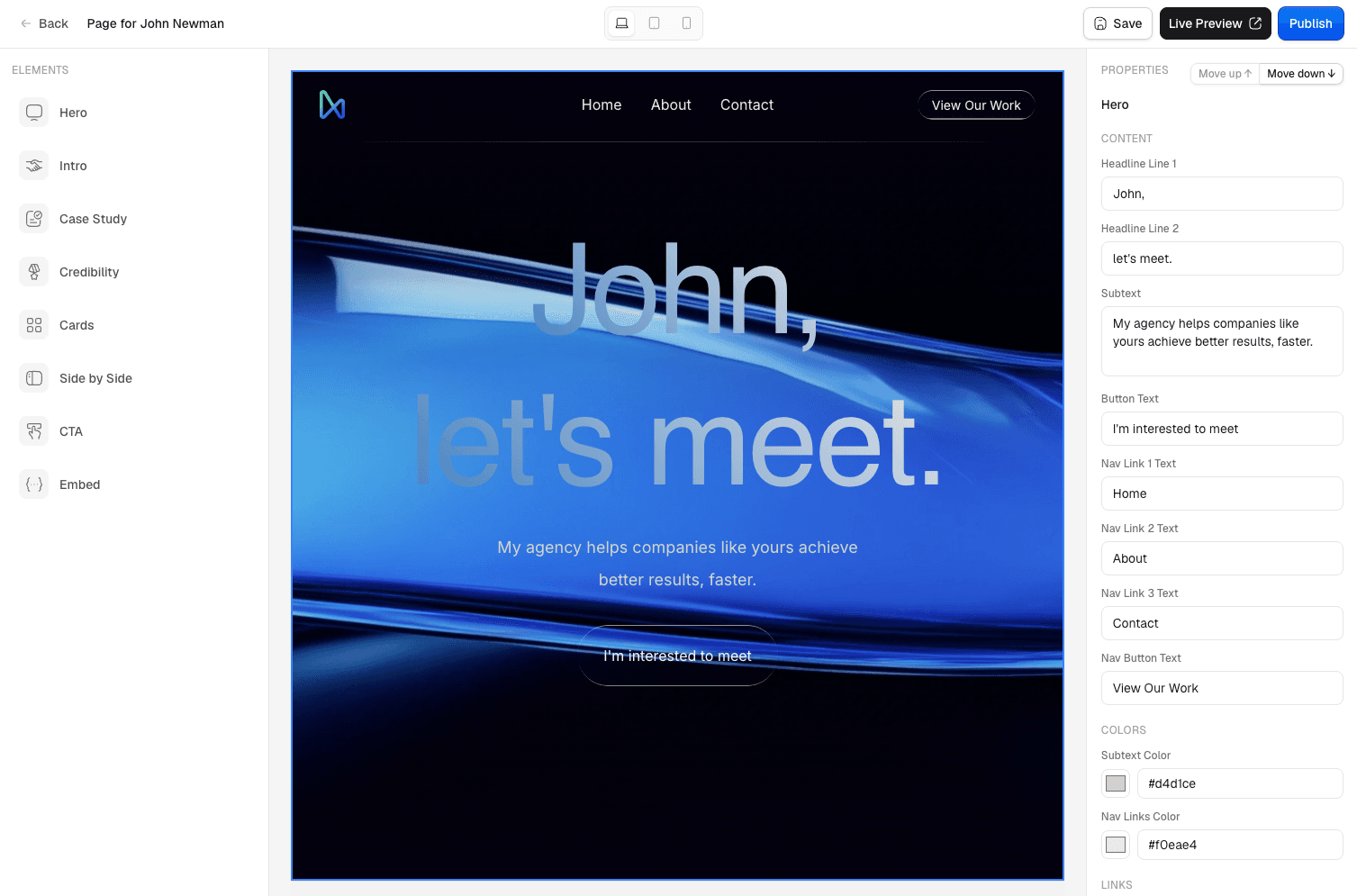
Inside ProspectPage, you drop in a CSV of your 25 accounts and generate 25 of these pages at once, each personalized to a single prospect. The logo, the headline, the proof point, and the copy adjust per row. What used to be an afternoon per page becomes one upload for the whole list, and every page comes with the open-and-scroll tracking that powers step 4.
So you get both at the same time: the depth of a page made for one person, and the reach of a normal sequence. That is the entire bet of the playbook, and it is the one part you cannot fully copy by hand.
Grab the template and build your first page free. Upload a list, send the next campaign to a page instead of the inbox, and let the opens tell you who to call.
Related reading
Personalized sales pages: the new outbound playbook
What a personalized sales page is, why it beats a deck, and how to build one fast.
How personalized web pages lift cold outreach reply rates by 37%
The data across hundreds of campaigns on what pairing every email with a page actually does.
9 personalized cold outreach techniques that actually book calls in 2026
Nine hand-made touches to stack on the playbook, from voice notes to AI scenes.